
The Most Important Infrastructure is Invisible.
Why Institutional Legitimacy May Be The Most Important Public Asset Cities Possess.

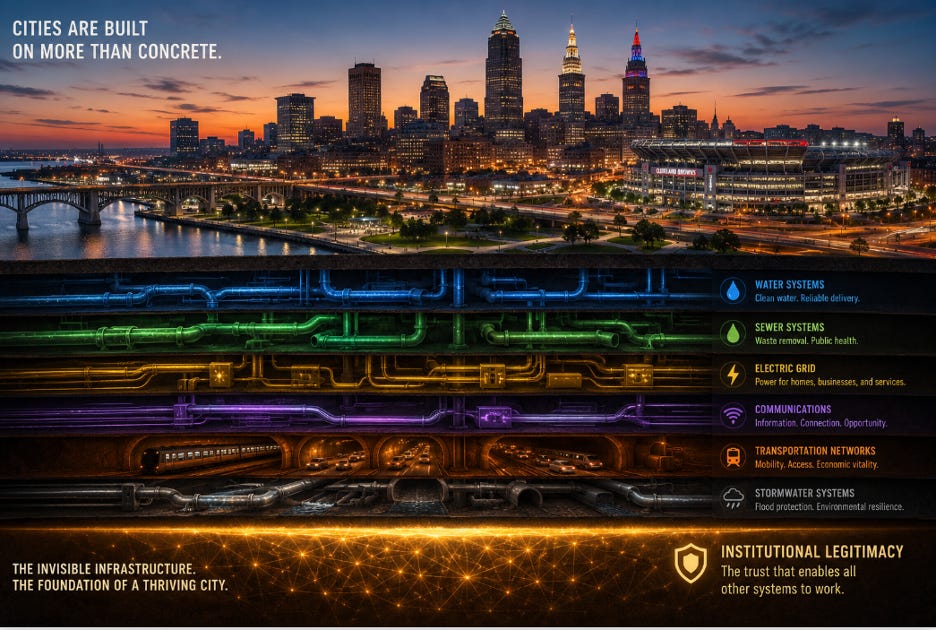
The Most Important Infrastructure Is Invisible: Why Institutional Legitimacy May Be The Most Important Public Asset Cities Possess.
In 2008, Chicago leased 36,000 parking meters to a private consortium for $1.15 billion. The 75-year agreement became one of the most criticized municipal transactions in American history. Taxpayers bear its costs; investors have earned handsome returns.
The lasting damage, however, was not financial.
The deal embedded itself in Chicago’s civic memory as evidence that complicated public transactions often benefit insiders more than the public. Whether every criticism of the agreement was fair is almost beside the point. Once that perception took hold, future proposals involving privatization, public-private partnerships, or innovative financing were viewed through a lens of suspicion.
The parking meters continued to function. The city’s institutional legitimacy did not.
Discussions of urban infrastructure typically begin with roads, bridges, rail lines, water systems, and power grids. These visible networks make cities possible. Yet every successful city depends upon another form of infrastructure that cannot be photographed or poured in concrete.
It exists in the expectations people hold about one another and about the institutions that govern them. It is institutional legitimacy—the widespread belief that public decisions are generally made competently, fairly, transparently, and in the public interest.
Institutional legitimacy allows millions of strangers to cooperate every day. It enables residents to accept unfavorable zoning decisions because they believe the process was fair. It encourages businesses to invest because they expect contracts to be honored and regulations to be applied consistently.
Cities are built on concrete, but they function on legitimacy. Like roads and power grids, legitimacy is productive infrastructure. It lowers the cost of cooperation by reducing uncertainty about how public institutions will behave. When legitimacy is strong, millions solve collective problems without second-guessing the rules, norms, and enforcement practices that govern their interactions—and the institutions that resolve disputes.
Today, that invisible infrastructure is showing unmistakable signs of decay.
Americans disagree sharply about why.
Critics of Donald Trump point to transactional politics, weakened oversight, patronage, personal enrichment, and no-bid contracts like the Lincoln Memorial Reflecting Pool renovation. His defenders argue corruption is embedded in permanent institutions through bureaucratic self-interest, regulatory capture, congressional favoritism, waste, and politicization.
The political argument is fierce, yet beneath it lies an extraordinary point of agreement.
The disagreement is no longer over whether corruption exists. It is over where it resides.
That distinction matters: two forms of corruption can coexist.
Political corruption involves abusing public office for private gain—bribery, kickbacks, or favoritism. The other, institutional corruption—Lawrence Lessig’s term—is subtler: legal incentives gradually divert an institution from its public purpose.
Neither excludes the other.
Political corruption weakens institutions, which in turn encourages citizens to tolerate it, concluding every institution is already compromised. Each becomes evidence for the other. The result is a self-reinforcing cycle in which institutional legitimacy steadily erodes.
Public confidence in government has fallen to historic lows, while international measures of public-sector integrity suggest a similar decline. By September 2025, Pew found public trust in government at just 17%—down from 77% in 1964. No single indicator tells the entire story. Together, however, they point toward something deeper than dissatisfaction with individual leaders.
They suggest growing skepticism that US public institutions themselves can be trusted to act impartially.
The consequences are especially visible in America’s cities, where citizens encounter government most directly—and where legitimacy becomes immediately tangible.
Urban policy is often presented as a series of technical challenges. Housing shortages require zoning reform. Congestion requires transportation planning. Aging infrastructure demands investment. Climate resilience calls for engineering. Public safety requires effective policing.
Each of these matters.
None is sufficient.
Every urban policy ultimately depends upon citizens believing that public institutions are capable of making legitimate decisions. Once that confidence weakens, the debate changes. The central question is no longer, “What should we build?” It becomes, “Whose interests are really being served?”
Housing illustrates the problem.
Economists have compiled compelling evidence that metro areas need substantially more housing. Yet proposals for higher-density development routinely encounter fierce neighborhood opposition. While some resistance undoubtedly reflects concerns about property values or neighborhood character, many citizens express a different concern: whether development decisions are actually being made in the public interest.
Campaign contributions, opaque negotiations, discretionary approvals, and inconsistent enforcement of zoning regulations create the perception that influence matters more than rules. Whether every suspicion is justified is almost beside the point. Once legitimacy is questioned, every proposal inherits that distrust.
The problem compounds where housing markets are concentrated and development depends on repeated discretionary approvals rather than predictable by-right rules. Large developers can hire attorneys, consultants, and lobbyists to navigate political complexity; smaller builders often cannot. Citizens observe these structural advantages and conclude that the system favors insiders—not necessarily because individual decisions are corrupt, but because the process itself appears tilted.
Legitimacy begins to erode long before anyone is convicted of wrongdoing.
Consider the debate over the Cleveland Browns’ proposed stadium in the nearby suburb of Brook Park, Ohio. Whether the project benefits Northeast Ohio matters less than the questions it raises about subsidies, financial risk, transparency, and fair return. Those concerns have transformed a debate over stadium economics into a debate over institutional trust.
What is striking is not the disagreement itself. Democracies are built on disagreement. Rather, the debate increasingly turns on whether citizens trust the institutions making the decisions. Once those questions dominate the conversation, every subsequent decision is viewed through a lens of institutional trust—or distrust. The stadium becomes more than a development project. It becomes a referendum on the legitimacy of the process itself.
Once institutional legitimacy is damaged, citizens increasingly evaluate public decisions according to whether they trust the institution making them rather than the merits of the proposals themselves.
Eventually, citizens stop judging public decisions on their merits and judge them instead by whether they trust the institution.
Corruption should therefore be understood not merely as an ethical problem.
It is an economic problem.
It is an urban problem.
Most importantly, it is an institutional problem.
Distrust raises housing costs as planning becomes contentious. It raises infrastructure costs as procurement is viewed with suspicion. It discourages talented people from entering public service while encouraging businesses, nonprofits, and civic organizations to work around government rather than through it.
The hidden cost of corruption is measured not only in diverted or stolen dollars but also in opportunities never pursued because citizens no longer believe collective action can succeed.
Institutional legitimacy does not exist in isolation.
Jane Jacobs observed that thriving cities depend on countless everyday interactions among strangers. Sidewalks, neighborhood businesses, parks, libraries, and public markets allow people from different backgrounds to encounter one another, building habits of cooperation and mutual confidence.
Those interactions, however, occur within a broader institutional framework.
Citizens who lose confidence in courts, planning departments, schools, police, or officials become less willing to cooperate through them. Research suggests social trust and institutional trust reinforce one another; as one declines, the other follows.
The disappearance of local journalism has accelerated this process. Local newspapers historically served as watchdogs and translators, helping citizens understand their governments while exposing misconduct. As those institutions disappear, corruption becomes harder to detect, misinformation spreads more easily, and public cynicism deepens.
Rebuilding legitimacy therefore requires more than prosecuting individual wrongdoers or electing new officials.
Like any infrastructure, it requires continuous maintenance.
The first task is competence. Governments should honestly assess corruption, administrative performance, procurement, regulatory complexity, and citizens’ everyday experiences with public services. For most Americans, government is experienced not in constitutional debates but in renewing a license, obtaining a permit, or seeking emergency aid. Administrative competence is not a bureaucratic luxury; it is a principal foundation of institutional legitimacy.
The second task is transparency. Agencies should routinely publish meaningful performance measures—permitting timelines, procurement data, audit findings, service quality, and corrective actions following major failures. Institutions that acknowledge mistakes and demonstrate improvement are trusted more than those that claim they never err.
The third task is integrity. Strong ethics oversight, transparent campaign finance, meaningful disclosure, and sensible conflict-of-interest rules assure citizens that public office serves the public, not private interests.
Cities should become laboratories of institutional renewal. Transparent procurement, simpler permitting, responsive services, and meaningful citizen participation can demonstrate government can learn, adapt, and earn confidence.
Finally, civic education should not ask Americans to trust government uncritically. It should equip them to understand institutions, recognize their limits, hold them accountable, and improve them through informed participation.
A healthy democracy requires skeptical citizens.
It cannot survive cynical ones.
America has endured corruption before. What distinguishes this moment is not that corruption exists, but that citizens increasingly regard it as inevitable. They assume every institution is compromised, every policy serves hidden interests, and every public decision benefits someone other than the public.
That belief may become more destructive than corruption itself.
Roads can be repaved. Bridges rebuilt. Water systems modernized. But once institutional legitimacy collapses, collective action becomes harder because citizens cease believing shared problems can be solved through shared institutions.
The most important infrastructure in any city is therefore invisible.
It consists of the confidence that public institutions will generally act competently, impartially, transparently, and in the public interest.
Without that confidence, every other form of infrastructure becomes more expensive to build, more difficult to maintain, and harder to defend politically.
Cities are sustained not by concrete and electricity alone, but by legitimacy.
Bill Bowen
The root of many of these institutional issues is the lack of reform in many cities. The reform movement in the later 1880's and early 1900's saw the rise of city managers and professionalization. Many cities did not reform or like Cleveland used the perception of reform to continue political machine type politics. Many perceive mayors as the epitome of democracy but the office of mayor is a political gateway to a political career at state and national levels. Ambition needs to be linked to institutions not individual careers. Ambition and definitions of democracy that do not understand government can undercut institutions. Having a professional such as a city manager reporting to an elected council that can fire her without cause is more democratic than electing a mayor who can control the local politics for ambition.
I think we have "shadow" cities and towns - where, unlike Chicago, little scrutiny happens of shady deals around town. Stamford, CT stands as one example. It's home to Purdue Pharma and WWF. The firm where I worked - Gartner- went downhill and is now subject to a major stock fraud allegation. In shadow cities, there's no stakeholder tier keeping their eyes on things.
Another town in this "shadow" group: Arlington, outside of Boston. The major law firm is prominent in the town Center. But this same firm is regularly drawing state Bar investigations and rebukes. In another development, four city leaders are currently trying to sell a Girl Scout camp for $18 million dollars by breaking the original Trust. No town leader will say anything or discuss it publicly.
In Chicago, people speak up and they remember. In shadow cities, bad behavior takes place in plain sight, and there's a lack of stakeholders to hold people accountable.